Sphero Indi Is a Tiny Robotic Car That Helps Children Learn Programming

Instagram will Not Show Adds In IGTV Videos; Share Revenue With Creators


Instagram will Not Show Adds In IGTV Videos; Share Revenue With Creators

By Techtonic group

We've been hearing about Instagram's revenue-sharing plan for a long time. And well, Instagram has finally detailed them today in an official blog post. One, the company's long-form video platform, IGTV, will start showing ads and secondly, Instagram Live viewers will be able to purchase badges to support an influencer.

First, let's talk about ads in IGTV videos. Instagram reveals that ads will show up in IGTV videos starting this week. It has partnered (via The Verge) with a handful of English-speaking creators and advertising partners such as Ikea, Puma, and others.

As per the blog post, you will only see ads when you tap the 'Watch IGTV video' button from your Instagram feed. The ads will be built for mobile and can be as long as 15-seconds. Currently, tapping an IGTV video in the feed makes it go full-screen and play from where you left off. You will now first see an ad and then the playback will continue.

"We'll test various experiences within IGTV ads throughout the year - such as the ability to skip an ad - to make sure the final result works well for people, creators, and advertisers," adds Instagram. The company will share an "industry standard" 55 percent cut with creators.

Ads in IGTV videos are currently limited to the United States but you can expect it to find its way to creators worldwide over the coming months. You can see how ads will look in IGTV videos in the header image above.

  • Live Video Badges

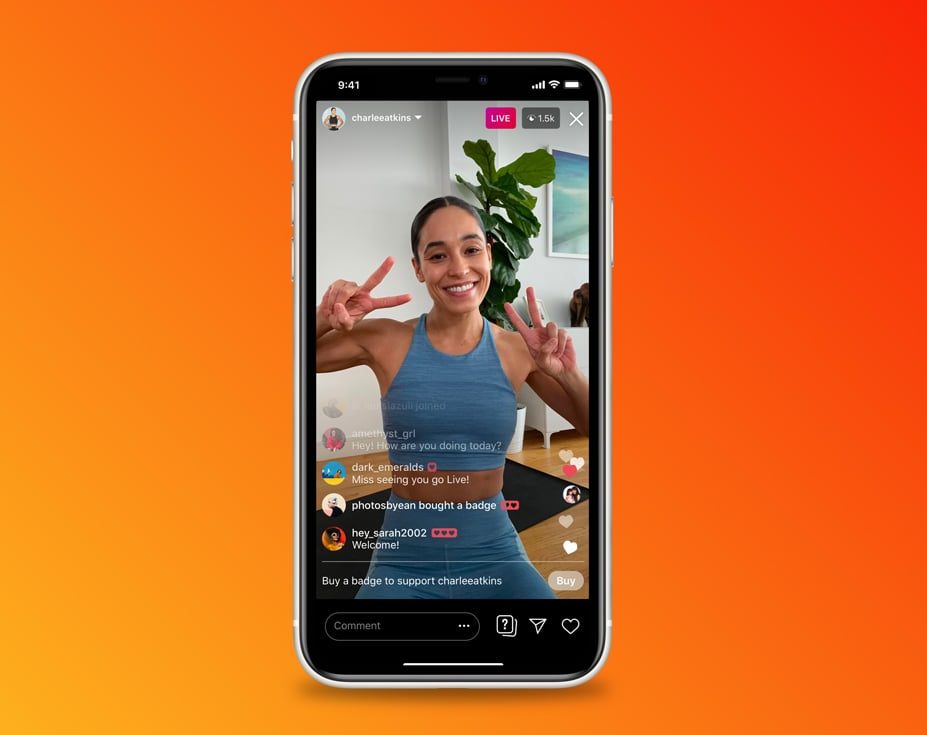
Instagram takes cues from Twitch and YouTube for this next feature. The same way that you subscribe to a creator on Twitch and see a badge next to your name in chat, Instagram will let users purchase badges during a live video to support their favorite creators.

These badges will then show up next to their username in the live stream chat, giving them a better chance to stand out and unlock additional rewards. They will get access to a special heart they can share during the live video.

Users will be able to choose from among three tiers, represented by hearts, that will show up next to their username in chat. One heart tier for $0.99, two hearts tier for $1.99, and three hearts tier for $4.99. You can see how the badge for each tier looks like in the image above.

Creators will be able to see who has purchased a badge, along with a placement list. The company revealed to The Verge that it will not take a revenue cut from creators using Badges right now. It plans to scale the feature and introduce revenue sharing in the next few months.

Instagram will begin testing Badges next month with a small group of creators and businesses. Over the coming months, it will expand this feature across the US, Brazil, UK, Germany, France, Italy, Turkey, Spain, and Mexico. So yes, Instagram is finally giving its creators an avenue to earn money from the content they post on the photo-sharing app.

Comments

Popular posts from this blog

Here is the First-Ever Video That Was Posted on YouTube

Here is the First-Ever Video That Was Posted on YouTube By Techtonic group Fifteen years ago, on Valentines' Day of 2005, the domain name "www.youtube.com" went live. The following months saw developments of the website and the first-ever video on the platform was posted on April 23, 2005. The YouTuber who shared the video was none other than one of the founding members, Jawed Karim. The YouTube that we know now is a massive video streaming platform with innumerable audience members. However,  it is fascinating to see from where the platform started its journey . So, in this article, I want to talk about the very first video that was uploaded on the platform, and surprisingly, it still exists. So, the 240p, grainy video, titled "Me at the zoo", shows a 25-year-old Jawed Karim, one of the founders of YouTube, standing in front of a group of elephants at the San Diego Zoo.  The 18-second video went live on April 23, 2005, and it is still there with ove...

10 Best File Manager Apps for Android You Should Use

  Almost all Android smartphones   ship with a built-in File Manager app   today. However, not all OEM file managers offer the level of features and functionality that come with third-party apps on the Google Play Store. So today, we will tell you about the 10 best third-party file manager apps (often also referred to as file browser or file explorer) for Android. These apps will help you better organize your files and folders on an Android smartphone. Best File Manager Apps for Android (Updated May 2021) The best file manager apps on Android let you browse your files, find your downloads, manage your storage space, and more. There are plenty of file managers on Android, and most of them are free. While some of them offer you premium features for a small charge, others are ad-supported. So without any further delay, let’s check out the best file manager apps on Android. Table Of Contents  Note:  The apps mentioned in this article are meant for Android smartphone...

How to Remotely Access Your Raspberry Pi from Windows, Mac, Linux, & Chrome OS

  How to Remotely Access Your Raspberry Pi from Windows, Mac, Linux, & Chrome OS We have already written a detailed guide on  how to use a Windows laptop as a monitor for Raspberry Pi , and it requires a wired ethernet connection. However, if you want to remotely access Raspberry Pi from your Windows 10, Mac, or Linux PC, you can do so with Wi-Fi and VNC server. In this article, we also explain the steps to connect to your Raspberry Pi remotely from a Chromebook in detail. Even if you are a beginner, you can follow the instructions and get it running in a few minutes. So without any delay, let’s go through the tutorial. Remotely Access Raspberry Pi From Windows, Mac, Linux & Chromebook (2021) Before establishing a remote connection, you will need to connect Raspberry Pi to your computer through the  wired ethernet medium for a quick one-time setup . This is essential to connect the Raspberry Pi to your Wi-Fi home network. As a result, an IP address will be assigne...