
Sphero Indi Is a Tiny Robotic Car That Helps Children Learn Programming

Microsoft Adds Dual-Screen Emulation to Cromium Ahead of Surface Duo Launch


Microsoft Adds Dual-Screen Emulation to Cromium Ahead of Surface Duo Launch

By Techtonic group

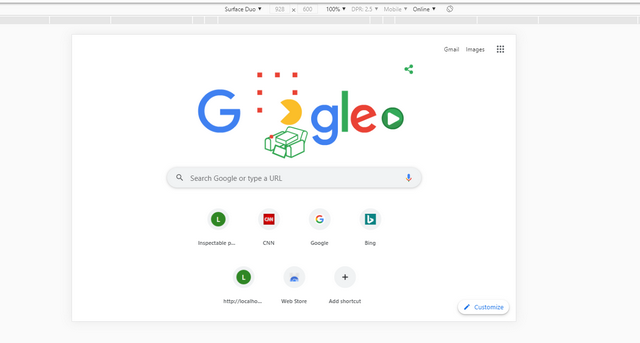
With dual-screen devices like the Surface Duo expected to be launched this year, Microsoft is trying to ensure that developers can add support for the new form-factor to their websites, apps and services with relative ease. The company has now added dual-screen support to the built-in F12 emulator in Chromium as an experimental feature that can only be activated by a flag.

According to notes on the Chromium Gerrit, the feature currently supports only the Microsoft Surface Duo and the Samsung Galaxy Fold, but works irrespective of whether the two screens are spanned horizontally or vertically. To implement the dual-screen functionality, the Emulation Bar now comes with an extra button to extend the device view from single-screen to dual-screen. What's more, the feature works with both hinged (dual-screen) and unhinged (folding-screen) devices.
2

Microsoft may have shelved its plans to launch the Windows 10X-powered Surface Neo this year, but the company is apparently still on track to launch the Android-powered Surface Duo before the end of this year. Both, of course, are dual-screen devices, which necessitates a significant amount of change to traditional software that were originally designed for single-screen devices.

Microsoft first proposed a dual-screen API in 2019 to help developers improve web experiences for devices like the Surface Duo and the Galaxy Fold. According to the company, developers will need to completely rethink how they work with platform primitives if they are to effectively mitigate some of the inherent challenges of dual-screen and folding devices. The latest addition to the Chromium code seems to be a step in that direction, so it will be interesting to see how that works out in enhancing the experience for end-users.

Comments

Popular posts from this blog

Here is the First-Ever Video That Was Posted on YouTube

Here is the First-Ever Video That Was Posted on YouTube By Techtonic group Fifteen years ago, on Valentines' Day of 2005, the domain name "www.youtube.com" went live. The following months saw developments of the website and the first-ever video on the platform was posted on April 23, 2005. The YouTuber who shared the video was none other than one of the founding members, Jawed Karim. The YouTube that we know now is a massive video streaming platform with innumerable audience members. However,  it is fascinating to see from where the platform started its journey . So, in this article, I want to talk about the very first video that was uploaded on the platform, and surprisingly, it still exists. So, the 240p, grainy video, titled "Me at the zoo", shows a 25-year-old Jawed Karim, one of the founders of YouTube, standing in front of a group of elephants at the San Diego Zoo.  The 18-second video went live on April 23, 2005, and it is still there with ove...

10 Best File Manager Apps for Android You Should Use

  Almost all Android smartphones   ship with a built-in File Manager app   today. However, not all OEM file managers offer the level of features and functionality that come with third-party apps on the Google Play Store. So today, we will tell you about the 10 best third-party file manager apps (often also referred to as file browser or file explorer) for Android. These apps will help you better organize your files and folders on an Android smartphone. Best File Manager Apps for Android (Updated May 2021) The best file manager apps on Android let you browse your files, find your downloads, manage your storage space, and more. There are plenty of file managers on Android, and most of them are free. While some of them offer you premium features for a small charge, others are ad-supported. So without any further delay, let’s check out the best file manager apps on Android. Table Of Contents  Note:  The apps mentioned in this article are meant for Android smartphone...

How to Remotely Access Your Raspberry Pi from Windows, Mac, Linux, & Chrome OS

  How to Remotely Access Your Raspberry Pi from Windows, Mac, Linux, & Chrome OS We have already written a detailed guide on  how to use a Windows laptop as a monitor for Raspberry Pi , and it requires a wired ethernet connection. However, if you want to remotely access Raspberry Pi from your Windows 10, Mac, or Linux PC, you can do so with Wi-Fi and VNC server. In this article, we also explain the steps to connect to your Raspberry Pi remotely from a Chromebook in detail. Even if you are a beginner, you can follow the instructions and get it running in a few minutes. So without any delay, let’s go through the tutorial. Remotely Access Raspberry Pi From Windows, Mac, Linux & Chromebook (2021) Before establishing a remote connection, you will need to connect Raspberry Pi to your computer through the  wired ethernet medium for a quick one-time setup . This is essential to connect the Raspberry Pi to your Wi-Fi home network. As a result, an IP address will be assigne...