
Sphero Indi Is a Tiny Robotic Car That Helps Children Learn Programming

This Cord by Google can Recognise a Squeeze or a Twist


This Cord by Google can Recognise a Squeeze or a Twist

By Techtonic group

We have seen Google come up with some unique technologies over the years (even killed many of those projects). However, I think the company's latest creation entirely changes the game for user interfaces (UIs). The "I/O Braid", which the company developed recently, is essentially a braided cable that can be squeezed, pinched and twisted to control various functions of an electronic device.

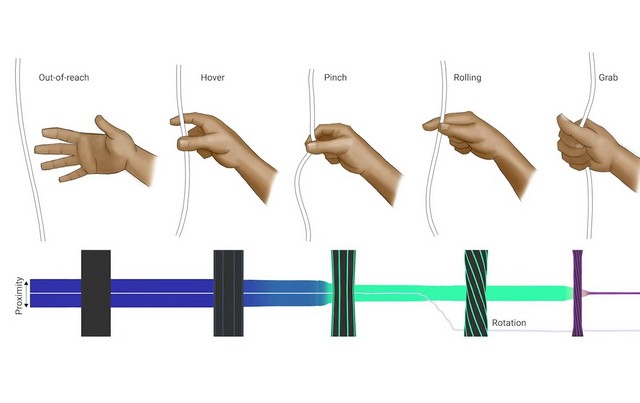
The company, in making the "I/O Braid", implemented the machine learning (ML) along with interactive textiles to enable the use of continuous and discrete gestures. This enabled the textile-based interactive cord to detect and recognise various gestures to control different functions of electronic devices.

Now, the "I/O Braid" is using a new technology, what Google is calling, a "Helical Sensing Matrix (HSM)". It is a braid that contains two types of yarns -- electrically insulated conductive textile yarns and passive support yarns, both of which enables the cord to sense and take gesture inputs from users.
Google braid 1

One of the key feats that the Mountain View-based tech giant was able to achieve with the HSM technology is the detection of the rotational gestures. This is the most challenging element in the "I/O Braid". However, the company was able to accomplish it by placing the two axial columns in an HSM that contains a common set of electrodes opposite to each other at 180-degrees. This activates a set of electrodes and allows tracking relative motion across the columns.

Google says that, although the project is still in its early stages of research and development, once it gets commercialised, this can be implemented in numerous electronic devices and even clothing. For instance, in the future, the "I/O Braid" can be used to make drawstrings in hoodies and jackets that can connect to smartphones and control various functions by squeezing, tapping, or twisting the drawstrings itself.

You can check out the official blog post by Google to know all about the "I/O Braid". There is also a video (below) demonstrating the complete tech in brief.


Comments

Popular posts from this blog

Here is the First-Ever Video That Was Posted on YouTube

Here is the First-Ever Video That Was Posted on YouTube By Techtonic group Fifteen years ago, on Valentines' Day of 2005, the domain name "www.youtube.com" went live. The following months saw developments of the website and the first-ever video on the platform was posted on April 23, 2005. The YouTuber who shared the video was none other than one of the founding members, Jawed Karim. The YouTube that we know now is a massive video streaming platform with innumerable audience members. However,  it is fascinating to see from where the platform started its journey . So, in this article, I want to talk about the very first video that was uploaded on the platform, and surprisingly, it still exists. So, the 240p, grainy video, titled "Me at the zoo", shows a 25-year-old Jawed Karim, one of the founders of YouTube, standing in front of a group of elephants at the San Diego Zoo.  The 18-second video went live on April 23, 2005, and it is still there with ove...

10 Best File Manager Apps for Android You Should Use

  Almost all Android smartphones   ship with a built-in File Manager app   today. However, not all OEM file managers offer the level of features and functionality that come with third-party apps on the Google Play Store. So today, we will tell you about the 10 best third-party file manager apps (often also referred to as file browser or file explorer) for Android. These apps will help you better organize your files and folders on an Android smartphone. Best File Manager Apps for Android (Updated May 2021) The best file manager apps on Android let you browse your files, find your downloads, manage your storage space, and more. There are plenty of file managers on Android, and most of them are free. While some of them offer you premium features for a small charge, others are ad-supported. So without any further delay, let’s check out the best file manager apps on Android. Table Of Contents  Note:  The apps mentioned in this article are meant for Android smartphone...

How to Remotely Access Your Raspberry Pi from Windows, Mac, Linux, & Chrome OS

  How to Remotely Access Your Raspberry Pi from Windows, Mac, Linux, & Chrome OS We have already written a detailed guide on  how to use a Windows laptop as a monitor for Raspberry Pi , and it requires a wired ethernet connection. However, if you want to remotely access Raspberry Pi from your Windows 10, Mac, or Linux PC, you can do so with Wi-Fi and VNC server. In this article, we also explain the steps to connect to your Raspberry Pi remotely from a Chromebook in detail. Even if you are a beginner, you can follow the instructions and get it running in a few minutes. So without any delay, let’s go through the tutorial. Remotely Access Raspberry Pi From Windows, Mac, Linux & Chromebook (2021) Before establishing a remote connection, you will need to connect Raspberry Pi to your computer through the  wired ethernet medium for a quick one-time setup . This is essential to connect the Raspberry Pi to your Wi-Fi home network. As a result, an IP address will be assigne...