Sphero Indi Is a Tiny Robotic Car That Helps Children Learn Programming

Xiaomi Japan Apologies After Using Nuclear Bomb Reference in Their Ads


Xiaomi Japan Apologies After Using Nuclear Bomb Reference in Their Ads

By Techtonic group

Xiaomi's Japan division did an "oopsie" recently by publishing a controversial advertisement for the Redmi Note 9 Pro. The company drew references from one of the biggest disasters that Japan faced back in 1945 when the US dropped a nuclear bomb on the city of Nagasaki. So, after getting a lot of backlash from the public, the Japanese division of the Chinese smartphone-makers released an official apology letter recently.

The feud started when Xiaomi Japan released an ad for the Redmi Note 9 Pro in the country showcasing the smartphone's features like its performance and specifically the 30W fast charging. After the backlash, the video was removed immediately. However, as it is the internet we are talking about, the controversial part of the video still exists and you can check it out below.

As you can see above, the controversial imagery was in the part where the video tried to showcase the battery of the smartphone and its fast-charging feature. It was in this part where they showed a man eating a battery-turned-chocolate and inflating to become a balloon-like fat man. Then he flew off to the sky just above a city and exploded in between the clouds.

Now, the exploding part was an obvious reference to a bomb blast, however, the man becoming fat was also a major point of the controversy. See, the nuclear bomb that the USA dropped on Nagasaki almost 75 years ago was codenamed the "Fat Man".

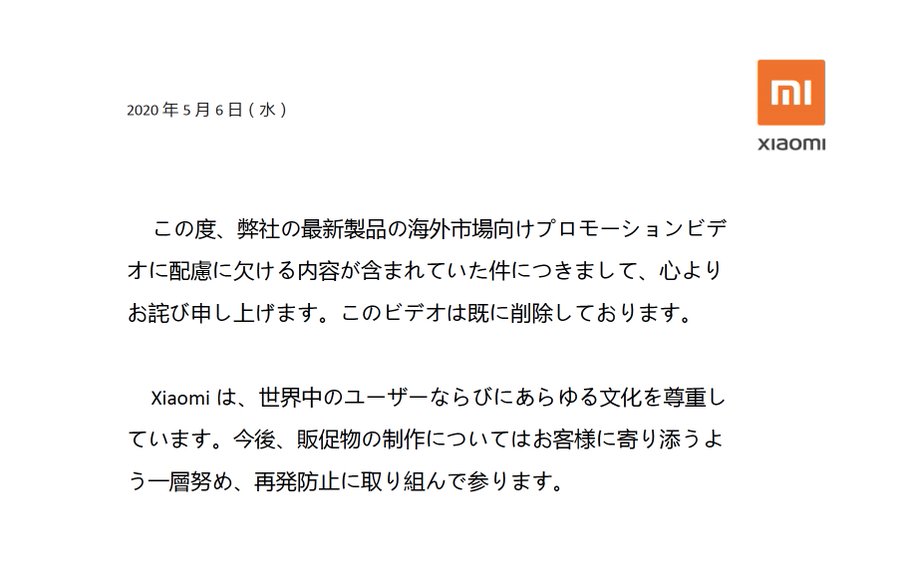
So, after receiving a huge amount of resentment from the Japanese citizens, Xiaomi shared a tweet (below) with an official letter of apology stating that the company respects its users and an act like this won't happen in the future.

Although the letter is in the Japanese language, folks over at Android Authority presented a rough translation of the letter and it goes like this:

"This latest product promotion for the overseas market contained ill-considered content and the video has been removed. Xiaomi respects users and cultures around the world, and we will be closer to our users when producing new products that promote them. We will do everything we can to prevent it from happening again in the future and to resolve the problem."

Now, I don't understand how the company's Japanese division thought that they could show representations like these and get away with it, considering that very disaster marked a moment in the history of warfare. The city was almost wiped off from the face of Earth with that nuclear blast and the citizens face its consequences even today.

Comments

Popular posts from this blog

Here is the First-Ever Video That Was Posted on YouTube

Here is the First-Ever Video That Was Posted on YouTube By Techtonic group Fifteen years ago, on Valentines' Day of 2005, the domain name "www.youtube.com" went live. The following months saw developments of the website and the first-ever video on the platform was posted on April 23, 2005. The YouTuber who shared the video was none other than one of the founding members, Jawed Karim. The YouTube that we know now is a massive video streaming platform with innumerable audience members. However,  it is fascinating to see from where the platform started its journey . So, in this article, I want to talk about the very first video that was uploaded on the platform, and surprisingly, it still exists. So, the 240p, grainy video, titled "Me at the zoo", shows a 25-year-old Jawed Karim, one of the founders of YouTube, standing in front of a group of elephants at the San Diego Zoo.  The 18-second video went live on April 23, 2005, and it is still there with ove...

Instagram Parteners with Swiggy, Zomato to Let Resturant Add 'Food Order' Stickers in Stories

Instagram Parteners with Swiggy, Zomato to Let Resturant Add 'Food Order' Stickers in Stories By Techtonic group Instagram recently gave users the option to promote small (and local) businesses by placing a sticker in their Stories. Now, the company has partnered with two of India's renowned food delivery apps -  Swiggy and Zomato  - to bring a similar feature to the restaurant owners. It has debuted a new  'Food Order' sticker  that restaurants can include in their Stories to drive sales. The Coronavirus-led lockdown saw almost all restaurants and eateries shut shop for several days. And even when they opened, netizens have been wary to eat outside or order in due to hygiene concerns. Well, as restaurants open up in line with the WHO safety guidelines, they can now head to Instagram to find a new 'Food Orders' sticker in the Stories section. This new sticker is interactive and will  enable users to place food orders  simply by tapping on the sa...

Sphero Indi Is a Tiny Robotic Car That Helps Children Learn Programming

Robotic toys for learning are becoming more common in the market as kids turn more towards STEM learning. As a result, we’ve seen several modular and advanced robotic toys that are designed to help children learn the basic concepts of programming and problem-solving. And the Sphero indi is not that different. The Sphero indi Developed by renowned robotic-toy maker Sphero, the indi is essentially a toy car that helps children learn about the core concepts of problem-solving and logical thinking. The learning set comes with the indi, which the tiny robotic car, and a bunch of color-coded silicone-based tiles, designed to give the indi specific instructions. For instance, a green tile tells the car to move faster, a pink tile tells it to turn left, a yellow one instructs the car to drive slowly, and a red tile stops the car. So, the car comes equipped with a color sensor to detect the color of a tile over which it is driving and respond accordingly. Hence, using the Sph...