
Sphero Indi Is a Tiny Robotic Car That Helps Children Learn Programming

Edge PWAs Can Now Auto-Run on Windows Start-Up


Edge PWAs Can Now Auto-Run on Windows Start-Up

By Techtonic group

Microsoft Edge and Google Chrome will soon allow Progressive Web Apps (PWA) to run alongside Windows Start-up. As spotted by Techdows, the feature is live on the Canary builds of Edge and Chrome.

As of now, the feature exists behind an experimental flag. Once enabled, you will get an option to start the PWA when you sign in to your computer. The option exists in the installation prompt of the PWA.

You can try out the feature right now if you use the Canary builds of these browsers. To do so, access 'edge://flags' or 'chrome://flags' based on your browser of choice, enable 'Desktop PWAs run on OS login' flag, and restart your browser.

Although these browsers don't have a user interface to control startup of PWAs just yet, you can go the old-fashioned Task Manager way to control Startup applications. However, managing startup apps can get quite tricky as the entry doesn't reflect the name of the PWA being initialized.

For instance, I added PWA of Twitter and Starbucks to run on start-up, but Task Manager listed it as Microsoft Edge for both the entries, thereby making it difficult to individually identify them.
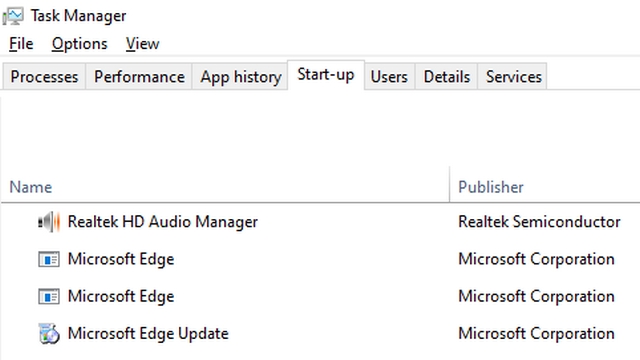
edge pwa task manager

That said, as Techdows points out, you could access Startup items from the Startup folder in case you would like to stop a specific app. You can quickly access the Startup folder by using the command '%APPDATA%\Microsoft\Windows\Start Menu\Programs\Startup' in Run dialog box.
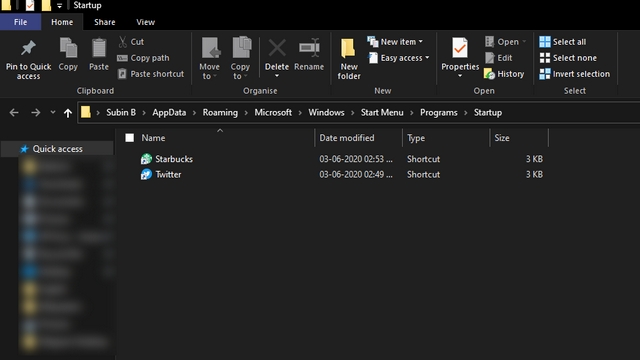
pwa startup folder

This step is a welcome move that would boost the widespread adoption of PWAs for a faster experience. We could expect the feature to be incorporated into the stable builds of Edge and Chrome in the coming months.

Comments

Popular posts from this blog

Here is the First-Ever Video That Was Posted on YouTube

Here is the First-Ever Video That Was Posted on YouTube By Techtonic group Fifteen years ago, on Valentines' Day of 2005, the domain name "www.youtube.com" went live. The following months saw developments of the website and the first-ever video on the platform was posted on April 23, 2005. The YouTuber who shared the video was none other than one of the founding members, Jawed Karim. The YouTube that we know now is a massive video streaming platform with innumerable audience members. However,  it is fascinating to see from where the platform started its journey . So, in this article, I want to talk about the very first video that was uploaded on the platform, and surprisingly, it still exists. So, the 240p, grainy video, titled "Me at the zoo", shows a 25-year-old Jawed Karim, one of the founders of YouTube, standing in front of a group of elephants at the San Diego Zoo.  The 18-second video went live on April 23, 2005, and it is still there with ove...

Instagram Parteners with Swiggy, Zomato to Let Resturant Add 'Food Order' Stickers in Stories

Instagram Parteners with Swiggy, Zomato to Let Resturant Add 'Food Order' Stickers in Stories By Techtonic group Instagram recently gave users the option to promote small (and local) businesses by placing a sticker in their Stories. Now, the company has partnered with two of India's renowned food delivery apps -  Swiggy and Zomato  - to bring a similar feature to the restaurant owners. It has debuted a new  'Food Order' sticker  that restaurants can include in their Stories to drive sales. The Coronavirus-led lockdown saw almost all restaurants and eateries shut shop for several days. And even when they opened, netizens have been wary to eat outside or order in due to hygiene concerns. Well, as restaurants open up in line with the WHO safety guidelines, they can now head to Instagram to find a new 'Food Orders' sticker in the Stories section. This new sticker is interactive and will  enable users to place food orders  simply by tapping on the sa...

Sphero Indi Is a Tiny Robotic Car That Helps Children Learn Programming

Robotic toys for learning are becoming more common in the market as kids turn more towards STEM learning. As a result, we’ve seen several modular and advanced robotic toys that are designed to help children learn the basic concepts of programming and problem-solving. And the Sphero indi is not that different. The Sphero indi Developed by renowned robotic-toy maker Sphero, the indi is essentially a toy car that helps children learn about the core concepts of problem-solving and logical thinking. The learning set comes with the indi, which the tiny robotic car, and a bunch of color-coded silicone-based tiles, designed to give the indi specific instructions. For instance, a green tile tells the car to move faster, a pink tile tells it to turn left, a yellow one instructs the car to drive slowly, and a red tile stops the car. So, the car comes equipped with a color sensor to detect the color of a tile over which it is driving and respond accordingly. Hence, using the Sph...