Sphero Indi Is a Tiny Robotic Car That Helps Children Learn Programming

Cloudflare Wants to Replace CAPTCHA with Hardware Security Keys


CAPTCHAs are annoying and we all agree that it is one of the worst parts of the modern web. However, the feature is essential to avoid bots and potential spam on online services. To find a middle ground, Cloudflare is exploring the possibility of using hardware security keys as a method to prove you’re a human.

Cloudflare Cryptographic Attestation of Personhood


As per Cloudflare, a user spends at least 32 seconds to complete a CAPTCHA challenge. Assuming that a user comes across a CAPTCHA once every 10 days, that’s roughly 500 human years wasted every single day. To avoid this, the company is proposing what it calls ‘Cryptographic Attestation of Personhood’.

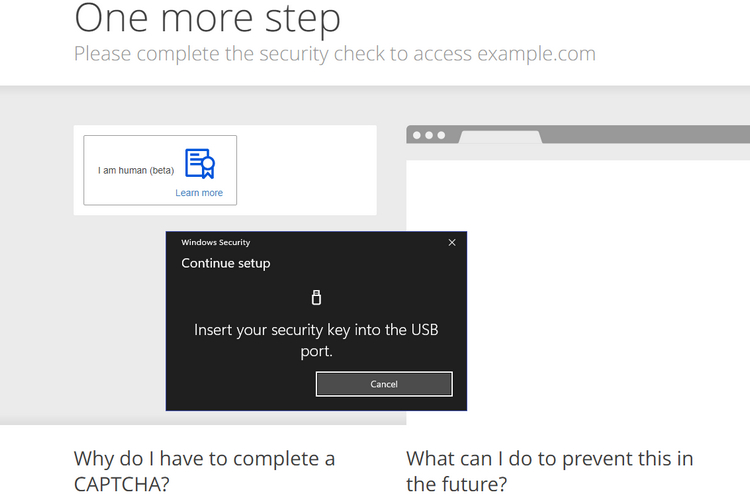
In a recent blog post, Cloudflare has detailed how the technology works. According to the company, users can plug in a hardware security key after clicking on the ‘I am a human’ prompt on supported websites. Soon after, a cryptographic attestation is sent to Cloudflare and the user presence is verified.

When Cloudflare tested this flow, it took just five seconds and three clicks. Cloudflare says you don’t have to worry about privacy concerns since the attestation is not linked to the user’s device. At this moment, the feature supports select security key makers that are part of the FIDO Alliance. Supported devices in the initial rollout include YubiKeys, HyperFIDO keys, and Thetis FIDO U2F keys. If you have a compatible security key, you can test the feature from this website.

“By offering a CAPTCHA alternative via a single touch backed by YubiKey hardware and public key cryptography, Cloudflare’s Cryptographic Attestation of Personhood experiment could help further reduce the cognitive load placed on users as they interact with sites under strain or attack,” said Christopher Harrell, Chief Technology Officer at Yubico.

Cloudflare’s cryptographic attestation of personhood works on devices that support Web Authentication API. The company says it works on all browsers on Windows, macOS, Ubuntu, and iOS 14.5. On the Android side of things, the feature works on Chrome with phones running Android 10 and later.

-by Techtonic Group

Comments

Popular posts from this blog

Here is the First-Ever Video That Was Posted on YouTube

Here is the First-Ever Video That Was Posted on YouTube By Techtonic group Fifteen years ago, on Valentines' Day of 2005, the domain name "www.youtube.com" went live. The following months saw developments of the website and the first-ever video on the platform was posted on April 23, 2005. The YouTuber who shared the video was none other than one of the founding members, Jawed Karim. The YouTube that we know now is a massive video streaming platform with innumerable audience members. However,  it is fascinating to see from where the platform started its journey . So, in this article, I want to talk about the very first video that was uploaded on the platform, and surprisingly, it still exists. So, the 240p, grainy video, titled "Me at the zoo", shows a 25-year-old Jawed Karim, one of the founders of YouTube, standing in front of a group of elephants at the San Diego Zoo.  The 18-second video went live on April 23, 2005, and it is still there with ove...

Instagram Parteners with Swiggy, Zomato to Let Resturant Add 'Food Order' Stickers in Stories

Instagram Parteners with Swiggy, Zomato to Let Resturant Add 'Food Order' Stickers in Stories By Techtonic group Instagram recently gave users the option to promote small (and local) businesses by placing a sticker in their Stories. Now, the company has partnered with two of India's renowned food delivery apps -  Swiggy and Zomato  - to bring a similar feature to the restaurant owners. It has debuted a new  'Food Order' sticker  that restaurants can include in their Stories to drive sales. The Coronavirus-led lockdown saw almost all restaurants and eateries shut shop for several days. And even when they opened, netizens have been wary to eat outside or order in due to hygiene concerns. Well, as restaurants open up in line with the WHO safety guidelines, they can now head to Instagram to find a new 'Food Orders' sticker in the Stories section. This new sticker is interactive and will  enable users to place food orders  simply by tapping on the sa...

Sphero Indi Is a Tiny Robotic Car That Helps Children Learn Programming

Robotic toys for learning are becoming more common in the market as kids turn more towards STEM learning. As a result, we’ve seen several modular and advanced robotic toys that are designed to help children learn the basic concepts of programming and problem-solving. And the Sphero indi is not that different. The Sphero indi Developed by renowned robotic-toy maker Sphero, the indi is essentially a toy car that helps children learn about the core concepts of problem-solving and logical thinking. The learning set comes with the indi, which the tiny robotic car, and a bunch of color-coded silicone-based tiles, designed to give the indi specific instructions. For instance, a green tile tells the car to move faster, a pink tile tells it to turn left, a yellow one instructs the car to drive slowly, and a red tile stops the car. So, the car comes equipped with a color sensor to detect the color of a tile over which it is driving and respond accordingly. Hence, using the Sph...