
Sphero Indi Is a Tiny Robotic Car That Helps Children Learn Programming

This Flexible Band-Aid Like Device Will Check for COVID-19 Symptoms


This Flexible Band-Aid Like Device Will Check for COVID-19 Symptoms

By Techtonic group

Since the Novel Coronavirus hit the world back in January of this year, we have seen many companies and organisations create ways to track COVID-19 -- the disease caused by Coronavirus. Now, there is a flexible band-aid-like device that can monitor for COV-19 symptoms by analysing coughs and breathing of a person.

The device, built by the Northweatern University of Chicago in collaboration with Shirley Ryan AbilityLab, sits at the base of a person's throat and monitors his/her coughing and breathing to predict if that person is infected.
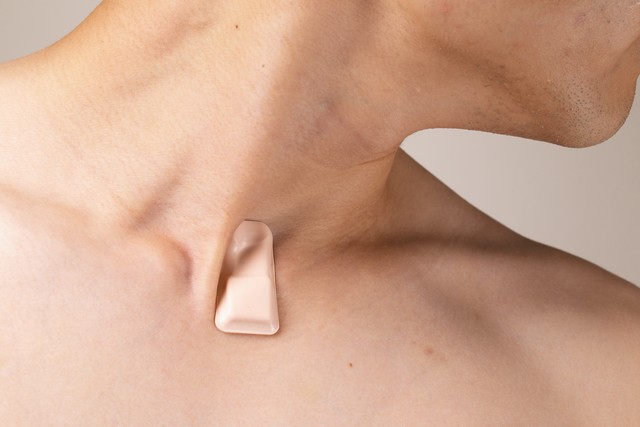
flexible COVID-19 monitor 3
Image: Northewestern University

It was previously a device that was used to monitor speech and swallowing in stroke-hit patients in recovering stages. However, the team tweaked the device to track the cough and breathing troubles (primary for COV-19 patients) of a person.

Now, the device does not use a microphone as it is too intrusive for a person's privacy. Instead, it uses a "high-bandwidth, tri-axis accelerometer to measure the movement of the surface of the skin", according to the Director of Northwestern University's Center on Bio-Integrated Electronics, John Rogers.

As it is a small flexible device integrated with a sensor, it does not have any ports to enable a wired connection. So, users can place the device on a wireless charger once a day to charge it up. While the device charges up, it also uploads all the data collected to a nearby iPad, which then uploads it to an HIPAA-approved cloud. Once the upload is completed, a proprietary AI analyses the data for any irregularities that are correlated with COVID-19.

The team is delivering the device to various healthcare institutions bundled with an iPad and the wireless charger in the box.
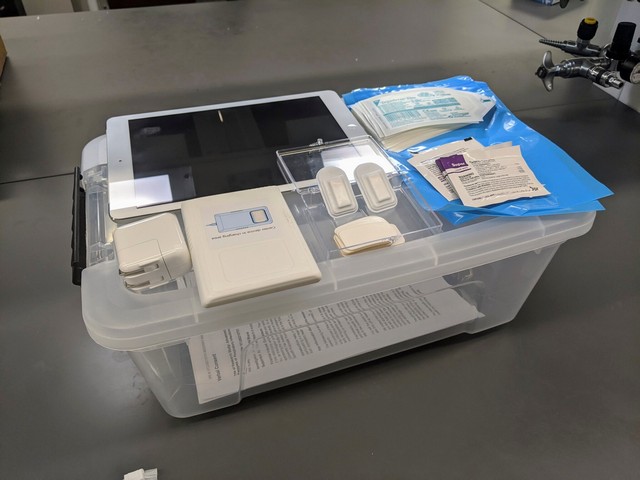
flexible COVID-19 monitor 2
Image: Northewestern University

Now, as the device is still in its early stages, the already AI-analysed data are double verified by human operators before they are sent to medical facilities. As of now, twenty-five people have been wearing the device for two weeks and as a result, around 1 TB of data has been uploaded to the cloud sized which is consist data of about 1500 hours.

Comments

Popular posts from this blog

Here is the First-Ever Video That Was Posted on YouTube

Here is the First-Ever Video That Was Posted on YouTube By Techtonic group Fifteen years ago, on Valentines' Day of 2005, the domain name "www.youtube.com" went live. The following months saw developments of the website and the first-ever video on the platform was posted on April 23, 2005. The YouTuber who shared the video was none other than one of the founding members, Jawed Karim. The YouTube that we know now is a massive video streaming platform with innumerable audience members. However,  it is fascinating to see from where the platform started its journey . So, in this article, I want to talk about the very first video that was uploaded on the platform, and surprisingly, it still exists. So, the 240p, grainy video, titled "Me at the zoo", shows a 25-year-old Jawed Karim, one of the founders of YouTube, standing in front of a group of elephants at the San Diego Zoo.  The 18-second video went live on April 23, 2005, and it is still there with ove...

Instagram Parteners with Swiggy, Zomato to Let Resturant Add 'Food Order' Stickers in Stories

Instagram Parteners with Swiggy, Zomato to Let Resturant Add 'Food Order' Stickers in Stories By Techtonic group Instagram recently gave users the option to promote small (and local) businesses by placing a sticker in their Stories. Now, the company has partnered with two of India's renowned food delivery apps -  Swiggy and Zomato  - to bring a similar feature to the restaurant owners. It has debuted a new  'Food Order' sticker  that restaurants can include in their Stories to drive sales. The Coronavirus-led lockdown saw almost all restaurants and eateries shut shop for several days. And even when they opened, netizens have been wary to eat outside or order in due to hygiene concerns. Well, as restaurants open up in line with the WHO safety guidelines, they can now head to Instagram to find a new 'Food Orders' sticker in the Stories section. This new sticker is interactive and will  enable users to place food orders  simply by tapping on the sa...

Sphero Indi Is a Tiny Robotic Car That Helps Children Learn Programming

Robotic toys for learning are becoming more common in the market as kids turn more towards STEM learning. As a result, we’ve seen several modular and advanced robotic toys that are designed to help children learn the basic concepts of programming and problem-solving. And the Sphero indi is not that different. The Sphero indi Developed by renowned robotic-toy maker Sphero, the indi is essentially a toy car that helps children learn about the core concepts of problem-solving and logical thinking. The learning set comes with the indi, which the tiny robotic car, and a bunch of color-coded silicone-based tiles, designed to give the indi specific instructions. For instance, a green tile tells the car to move faster, a pink tile tells it to turn left, a yellow one instructs the car to drive slowly, and a red tile stops the car. So, the car comes equipped with a color sensor to detect the color of a tile over which it is driving and respond accordingly. Hence, using the Sph...